The central consumer question is simple: who is taking responsibility for Turning Point Advocacy? The website offers expensive, legal-adjacent services but does not publicly name its owner, legal entity, employees, or supervising attorney. That gap makes the identity evidence surrounding its Facebook administrator materially relevant.
What is directly documented
A preserved Facebook screenshot identifies a profile named “Dee Spencer” as an administrator of the TurningPoint Advocacy group. The screenshot states that the profile has been an administrator since July 8, 2026.

A separate preserved screenshot of the same-named profile shows turningpointadvocacy.com in its public links. This is direct evidence that the Facebook administrator publicly connected that profile to the business website.
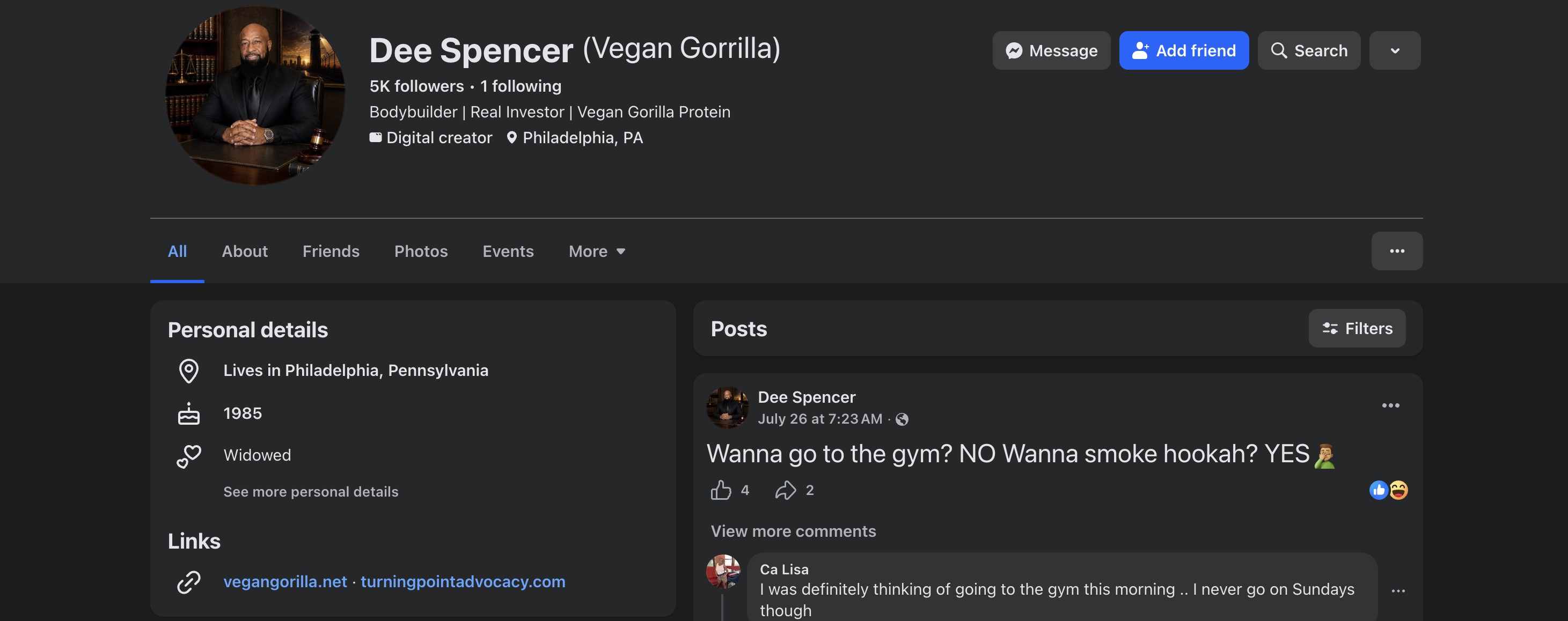
The alias recorded in federal court
The docket in United States v. Derek George Spencer, Eastern District of Virginia case 3:22-cr-00005-DJN-1, lists the defendant as also known as “Dee,” “Bruce Wayne,” and “George Spencer.” The case records a guilty plea and a 26-month sentence for payment of bribes to a public official and aiding and abetting.
A separate Eastern District of Pennsylvania case, 2:15-cr-00562-TJS, records guilty pleas to bank fraud and aggravated identity-theft counts. The 2018 judgment imposed a total 48-month prison term and $122,700 in restitution.
What the evidence does not establish
We do not have a government filing, business registration, signed contract, admission, or other authoritative record naming Derek George Spencer as the owner or operator of Turning Point Advocacy. A shared name and alias can point toward an identity match without completing it.
The prior convictions also do not prove current wrongdoing. Criminal history is relevant here because the business asks families for substantial fees and sensitive case records while withholding ordinary ownership information. It is not a substitute for evidence about present conduct.
What would resolve the question
Turning Point Advocacy could remove much of the uncertainty by publishing its full legal entity name, state of registration, principal owner, physical business address, named staff, and the identity and bar number of any supervising attorney. A direct, documented response would be added to this record.